
Unlike traditional slots where outcomes arrive in seconds, Tower Rush hands control to the player. You choose when to bank your profit, balancing greed against the ever-present risk of total loss. With 36 floors, a maximum win of £10,000, and an RTP of 98.5 per cent, the game sits comfortably in the crash and mines category—offering transparency, speed, and a dose of strategic decision-making that appeals to both cautious bettors and high-stakes thrill-seekers.
Tower Rush: key facts
| Provider | Galaxsys |
|---|---|
| Type | Crash / Tower-building |
| RTP | 98.5% |
| Volatility | High |
| Min / max bet | £0.01 / £100 |
| Max win | £10,000 |
| Mobile | Yes |
| Demo | Yes |
Tower Rush combines transparent mechanics, player control, and high RTP in a tense vertical race that rewards timing and nerve.
What is Tower Rush?
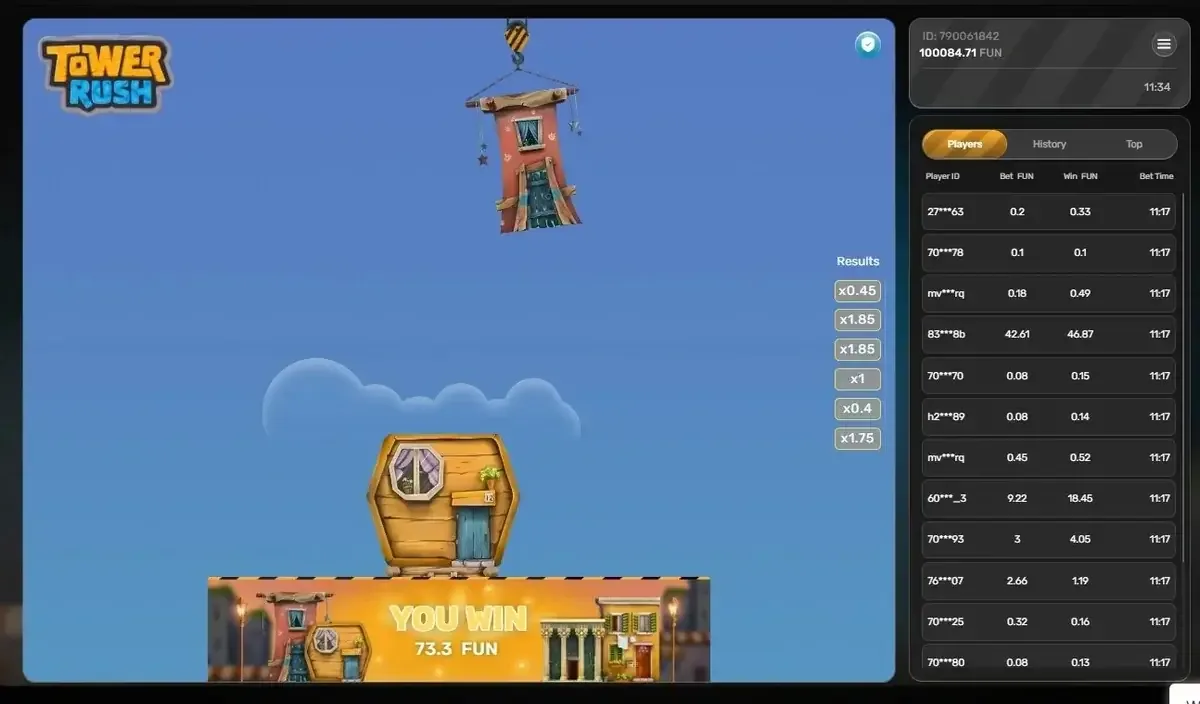
Tower Rush belongs to the growing family of crash games, where outcomes depend on timing rather than spinning symbols. You place a bet, then watch your character ascend a 36-storey tower as a multiplier increases with each successful floor. The catch: the tower can collapse at any moment, determined by provably fair algorithms before the round begins. Your task is to cash out before the crash, securing whatever multiplier you've reached. Wait too long, and you lose everything.
Galaxsys built Tower Rush on the same engine that powers other crash titles in their portfolio, ensuring smooth performance and reliable fairness verification. The game's interface is stripped back—no distracting animations or complex bonus wheels—just you, the tower, and a running tally of your potential winnings. This minimalist design keeps the focus squarely on the core decision: push higher for bigger rewards, or play it safe and pocket modest gains. The 98.5 per cent RTP sits well above industry averages for slots, reflecting the low house edge typical of crash games where transparency and player agency take centre stage.
Random bonus floors add occasional variety. Frozen Floor locks your current win total, allowing you to climb further without risking what you've already banked. Temple Floor and Triple Build introduce different mechanics that can amplify returns or extend your run. These bonuses trigger unpredictably, breaking up the rhythm and offering moments of reprieve in an otherwise relentless climb. While they don't fundamentally alter the core loop, they provide enough texture to keep sessions from feeling monotonous over extended play.
How to play Tower Rush
1: Set your stake and start the climb
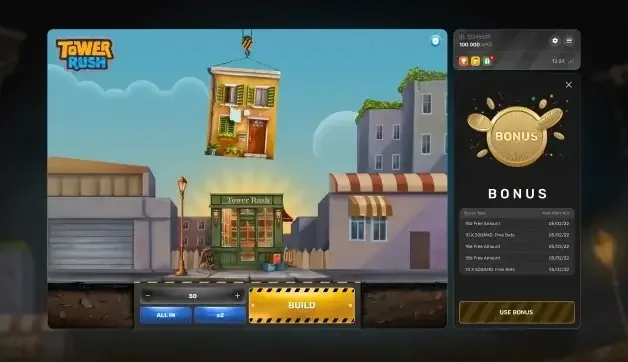
Choose a bet amount between £0.01 and £100 using the stake selector. Once you're satisfied, hit the start button to begin your ascent. The tower appears on screen, divided into 36 visible floors. Your character begins at ground level, and the multiplier starts ticking upwards as you clear each storey. There's no autoplay in the traditional sense, but you can configure auto-cashout thresholds if you prefer to remove manual decision-making from the equation.
2: Climb and watch the multiplier grow
Each floor you pass increases your active multiplier according to a fixed schedule. Early levels offer modest returns—think ×1.1, ×1.2—while the upper reaches deliver exponential jumps that can push your potential payout into serious territory. The tower's visual design shows your current position, how many floors remain above, and your live winnings total. Tension mounts as you rise, because the collapse can strike at any floor, and there's no warning. The game's provably fair system means the outcome is locked in before you start, but revealed only as you climb.
3: Cash out or risk the collapse
A prominent cashout button sits ready throughout your climb. Press it, and your accumulated winnings transfer instantly to your balance. Hesitate, and you gamble that the next floor won't be the one that brings everything down. If the tower collapses before you cash out, you lose your entire stake for that round. This binary outcome—secure profit or total loss—defines the Tower Rush experience. Deciding when to exit is part skill, part nerve, and entirely in your hands. Some players set fixed cashout points and stick to them; others play by feel, reading the tower's 'mood' and backing out when instinct whispers danger.
How much can you win on Tower Rush?
Tower Rush caps maximum winnings at £10,000, reached when you survive all 36 floors without cashing out or collapsing. That ceiling translates to a top multiplier around ×1,000, though the exact figure depends on your starting stake and the specific multiplier schedule for each floor. In practice, most players cash out long before reaching the summit—either because their nerve fails or because the risk-reward calculation tilts too heavily towards risk. The game's high volatility ensures that big wins are possible, but they come bundled with frequent losses that can drain your bankroll quickly if you chase the top prize recklessly.
The 98.5 per cent RTP is a long-term statistical average, not a guarantee for individual sessions. Over thousands of rounds, the house keeps 1.5 per cent of all money wagered. In short bursts, variance dominates: you might climb to floor 30 five times in a row, or collapse at floor 3 repeatedly. This high RTP does mean Tower Rush offers better theoretical value than most slots, where 96 per cent is considered generous. But remember, RTP applies to the collective, not the individual. You can still lose your entire session bankroll even with a player-friendly return rate, especially if you push for high multipliers without disciplined cashout rules.
- Minimum bet of £0.01 makes Tower Rush accessible to cautious players testing strategies or stretching small bankrolls.
- Maximum bet of £100 per round allows high rollers to chase four-figure payouts on a single successful climb.
- Bonus floors—Frozen Floor, Temple Floor, Triple Build—can boost returns beyond the standard multiplier schedule when they trigger.
- Provably fair algorithms let you verify each round's outcome independently, confirming the collapse point wasn't manipulated mid-climb.
- Auto-cashout settings remove emotional decision-making, executing your exit strategy at predetermined multipliers without hesitation.
Strategies and good habits for Tower Rush
Set fixed cashout targets and respect them
The simplest approach: decide before you start which multiplier you'll cash out at, then stick to it. Whether you choose ×2, ×5, or ×10, committing to a target removes the temptation to 'just go one more floor'. This discipline is especially important in crash games, where one extra second of hesitation can erase your entire profit. Track your results over 20 or 30 rounds to see which cashout points yield consistent returns versus which expose you to too many collapses. Adjust your target based on evidence, not emotion.
Use small stakes to learn the tower's rhythm
Tower Rush's high volatility means large bets can evaporate quickly if you misjudge the collapse frequency. Start with minimum stakes—£0.01 or £0.10—to build a feel for how often the tower survives to floor 10, 20, or 30. Pay attention to which zones feel 'safer' and where collapses cluster. While each round is independent and provably fair, mapping your subjective experience helps calibrate your risk tolerance. Once you're comfortable with the game's pace and your own cashout instincts, scale up your stakes gradually rather than jumping straight to maximum bets.
Treat bonus floors as windfalls, not strategy pillars
Frozen Floor and the other bonus modes trigger randomly, so you can't build a reliable strategy around them. When a bonus appears, it's a pleasant surprise that might extend your run or pad your winnings. But don't count on bonuses to rescue underwater rounds or justify reckless climbs. Base your cashout decisions on the standard multiplier schedule, and consider any bonus floors as icing rather than cake. This mindset keeps your approach grounded in what you can control—when to exit—rather than what you can't, which is when or whether a bonus will materialise.
Accept that the house edge always wins over time
Tower Rush's 98.5 per cent RTP is excellent, but it still means the casino keeps 1.5 per cent of all wagers in the long run. No strategy, however clever, can overcome this mathematical reality. Treat Tower Rush as entertainment with a cost, not a money-making scheme. Set a session budget you're comfortable losing entirely, and walk away—win or lose—when you hit that limit. Chasing losses or doubling stakes after collapses accelerates bankroll depletion. The only sustainable approach is disciplined bankroll management, fixed cashout rules, and the willingness to stop when the fun turns into frustration.
Free demo or real money?
Tower Rush offers a free demo mode that replicates the full game without requiring a deposit or account registration. The demo uses virtual currency, letting you climb the tower, test cashout strategies, and experience bonus floors without financial risk. It's an ideal sandbox for newcomers who want to understand the mechanics before committing real money, or for experienced players who want to trial different bet sizes and exit points. The demo's outcomes use the same provably fair algorithms as real-money play, so your practice sessions reflect genuine probabilities.
Real-money play introduces the psychological dimension that no demo can replicate. When your own funds are at stake, cashout decisions feel heavier, and the temptation to push 'just one more floor' intensifies. This emotional layer is part of Tower Rush's appeal—and its danger. If you choose real-money play, do so at a reputable online casino that holds a valid UK Gambling Commission licence. Verify the site's credentials, read withdrawal terms, and confirm that Tower Rush appears in the crash or mini-games lobby. Many operators bundle Galaxsys titles together, making them easy to locate once you know where to look.
Remember that both demo and real-money modes carry the same RTP and house edge. The demo won't 'let you win' to lure you into depositing, nor will real-money play suddenly become harder. The difference is purely financial: demo losses cost nothing, but demo wins can't be withdrawn. If you're tempted to chase big multipliers, exhaust your curiosity in demo mode first. Once you've seen how often the tower collapses at floor 25 versus floor 5, you'll make smarter decisions when your actual bankroll is on the line. And if you're under 18, stick to the demo—real-money gambling is illegal for minors in the UK, and responsible operators enforce strict age verification.
Our opinion on Tower Rush
Tower Rush succeeds where many crash games stumble: it delivers genuine tension without burying the player in needless complexity. The 36-floor structure is easy to grasp, the cashout mechanism is instant and transparent, and the provably fair system reassures players that outcomes aren't manipulated mid-round. Galaxsys has focused on the essentials—clear visuals, responsive controls, and a mathematically honest RTP—rather than dressing up the core loop with distracting animations or convoluted bonus rounds. The result is a game that respects your time and intelligence, offering straightforward risk-reward decisions without patronising tutorials or flashy gimmicks.
That said, Tower Rush won't suit everyone. Its high volatility means long losing streaks are inevitable, and the lack of traditional slot features—free spins, scatter symbols, progressive jackpots—will leave some players cold. If you crave variety within a single session, the repetitive climb-and-cashout rhythm may feel monotonous after 20 or 30 rounds. The bonus floors add occasional spice, but they're too infrequent to fundamentally alter the experience. Tower Rush is best enjoyed in short bursts, where each climb feels like a fresh challenge rather than a mechanical chore. Treat it as a palate cleanser between longer slot sessions, or as a focused test of nerve when you want something more interactive than spinning reels.
The 98.5 per cent RTP is a major selling point, especially for players who appreciate transparency and favour games with lower house edges. Combined with the £0.01 minimum bet, Tower Rush is accessible to cautious bettors who want to stretch their bankroll or experiment with different strategies. At the same time, the £100 maximum bet and £10,000 win cap give high rollers enough room to chase serious payouts without hitting artificial ceilings too quickly. Whether you're grinding small wins at low stakes or swinging for four-figure multipliers, the game accommodates your approach without forcing you into a single playstyle. That flexibility, paired with rock-solid mechanics and honest maths, earns Tower Rush a solid recommendation for anyone curious about crash games or looking for an alternative to traditional slots.
👍 Pros
- Exceptional 98.5% RTP, among the highest in the crash game category, offering better long-term value than most slots.
- Full player control over cashout timing, rewarding disciplined strategy and punishing reckless greed in equal measure.
- Provably fair system with transparent verification, ensuring each round's collapse point is predetermined and auditable.
- Wide betting range (£0.01 to £100) accommodates cautious beginners and high-stakes veterans without compromise.
- Clean, responsive interface with instant cashouts and no unnecessary clutter or forced animations.
👎 Cons
- High volatility leads to frequent total losses, which can drain bankrolls quickly without disciplined stake management.
- Repetitive core loop may feel monotonous over extended sessions, especially for players who prefer varied slot features.
- Bonus floors trigger too rarely to meaningfully diversify gameplay or serve as reliable strategic elements.
- Lack of traditional slot mechanics (free spins, multipliers, progressive jackpots) limits appeal for reel-focused players.
Frequently asked questions
What is the maximum win on Tower Rush?
Tower Rush caps maximum winnings at £10,000 per round. To reach this ceiling, you must survive all 36 floors without cashing out or collapsing, corresponding to a top multiplier around ×1,000 depending on your stake. In practice, most players cash out earlier to secure smaller but more attainable profits.
Can I play Tower Rush on mobile?
Yes, Tower Rush is fully optimised for mobile play on iOS and Android devices. The game runs in your mobile browser without requiring a separate app download, and the touchscreen controls are responsive and intuitive. The vertical tower layout suits portrait orientation particularly well, making it comfortable for one-handed play during commutes or short breaks.
Is Tower Rush provably fair?
Yes, Tower Rush uses provably fair algorithms to determine each round's collapse point before you start climbing. You can verify the outcome independently using cryptographic hashes provided by the game, confirming that the result wasn't altered mid-round. However, 'provably fair' guarantees mathematical honesty, not profitability—you can still lose money consistently even when every round is verifiably fair.
How does the auto-cashout feature work?
Auto-cashout lets you set a predetermined multiplier threshold where the game will automatically bank your winnings. For example, if you configure auto-cashout at ×5, the game exits your climb as soon as you reach that multiplier, transferring your profit instantly to your balance. This removes emotional decision-making and ensures you stick to your strategy even when tempted to push higher.
What are bonus floors in Tower Rush?
Bonus floors—Frozen Floor, Temple Floor, and Triple Build—trigger randomly as you climb. Frozen Floor locks your current win total, allowing you to continue ascending without risking what you've already earned. Temple Floor and Triple Build introduce different mechanics that can amplify returns or extend your run. These bonuses add occasional variety but appear too infrequently to base a reliable strategy around them.