This crash-style game strips away reels, paylines and bonus rounds in favour of pure decision-making: cash out early and bank a modest profit, or push your luck lane by lane in pursuit of exponential returns. InOut Games has carved a niche in the instant win category, and Chicken Road demonstrates why the format works—provided you approach it with eyes wide open about the house edge and volatility that underpin every single crossing.
Chicken Road: key facts
| Provider | InOut Games |
|---|---|
| Type | Crash / Instant Win Game |
| RTP | Not publicly disclosed |
| Volatility | High |
| Min / max bet | Varies by operator |
| Max win | £20,000 |
| Mobile | Yes |
| Demo | Available at partner casinos |
A slick, high-volatility instant game that rewards nerve and bankroll discipline but offers little in the way of strategic depth.
What is Chicken Road?
Chicken Road belongs to the crash game family—a format that explodes a multiplier until you cash out or the round ends abruptly. Instead of a rocket or aeroplane climbing a graph, you guide a pixelated chicken across a multi-lane road teeming with traffic. Each successful lane crossing increases your multiplier; a collision with a vehicle zeroes your bet. The aesthetic is deliberately retro—8-bit sprites, cheerful sound effects, a bright colour palette—but the mathematics beneath are identical to any other crash game: exponential payout potential coupled with exponential risk.
InOut Games positions Chicken Road as part of its 'mini-game' portfolio, a designation that highlights fast rounds, minimal rules, and mobile-first design. There are no wild symbols, no scatter triggers, no free spins. You stake, you click, you watch your chicken hop forward, and you decide—lane by lane—whether to collect your winnings or risk them for one more step. The entire mechanic hinges on timing and nerve, making it more akin to a quick-fire betting game than a traditional slot.
The game launched without fanfare but has quietly found an audience among players who prefer instant gratification over drawn-out bonus hunts. Partner casinos typically house it in the 'instant win' or 'arcade' category, alongside titles like Aviator or Plinko. RTP figures are not published by InOut Games, a common omission in the crash genre that leaves players reliant on anecdotal return data and operator transparency. What we can confirm is the £20,000 maximum payout, a ceiling that applies regardless of your stake size—critical information if you're wagering large sums per round.
How to play Chicken Road?
1: Set your stake and launch the round
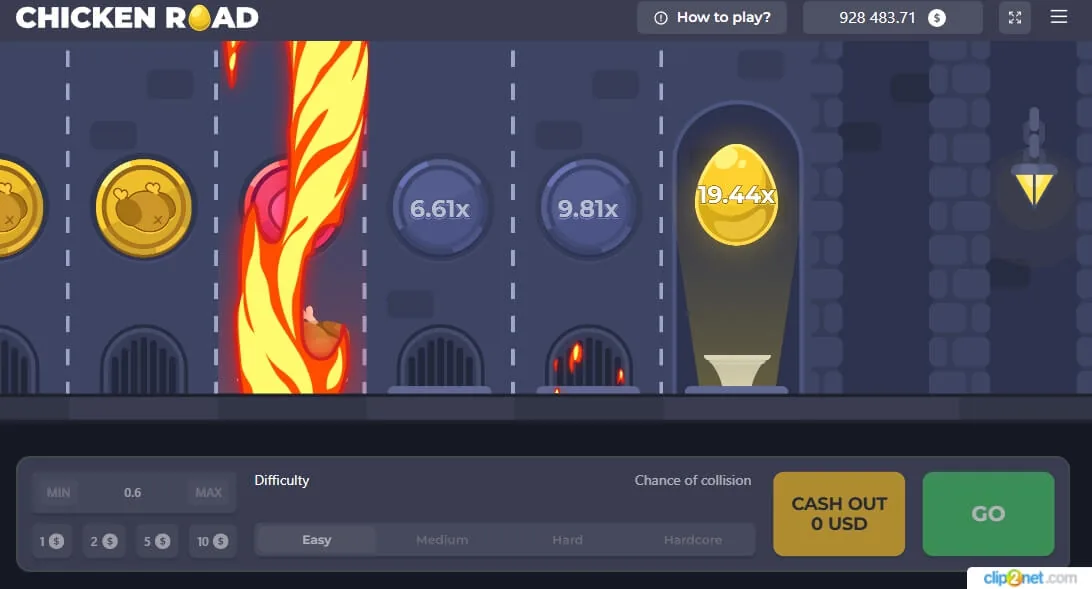
Before your chicken takes its first step, you select a bet amount using the on-screen controls. Most partner casinos allow stakes from as little as £0.10 up to operator-defined maximums, often in the £50–£100 range. Once you confirm the wager, the round begins automatically: your chicken appears at the bottom of the screen, and the first lane of traffic starts scrolling horizontally. There is no spin button, no autoplay countdown—just an immediate transition into live gameplay. The initial multiplier is 1.00×, meaning your stake is at risk but not yet growing.
2: Cross lanes and watch the multiplier climb
Each time your chicken successfully hops to the next lane without being struck, the multiplier increases according to a preset curve—typically doubling or adding a fixed increment per lane. InOut Games does not publish the exact progression, but testing suggests the curve steepens after the third or fourth lane, rewarding players who commit to deeper runs. Vehicles travel at varying speeds and densities; some lanes are sparse, others relentless. The game does not telegraph safe windows, so every crossing is a gamble informed only by visual timing and pattern recognition. You cannot pause the traffic or slow the animation—once you commit to a lane, the outcome resolves in under a second.
3: Cash out before a collision ends the round
At any point after your first successful crossing, a prominent 'Cash Out' button appears on screen, displaying your current multiplier and projected payout. Click it, and your winnings are credited immediately; the round ends, and you return to the bet-selection screen. Ignore it, and your chicken continues forward into the next lane. If a vehicle strikes your chicken at any stage, the round terminates instantly, your stake is lost, and the multiplier resets to zero. There is no second chance, no insurance mechanic, no 'near miss' consolation. The entire format is binary: collect or lose. This simplicity is the game's greatest strength and its most punishing characteristic.
How much can you win on Chicken Road?
The headline figure is £20,000—the absolute maximum payout regardless of stake or multiplier. In practice, hitting this cap requires either a colossal multiplier on a modest bet or a sizeable wager carried through multiple lanes. Because InOut Games does not disclose the multiplier ceiling or the precise lane-by-lane progression, it is impossible to reverse-engineer the exact number of crossings needed to reach the cap. Anecdotal reports from player communities suggest multipliers in excess of 100× are achievable, though vanishingly rare; most rounds that survive beyond five or six lanes end with payouts in the 10×–30× range.
Volatility is high, meaning long stretches of small losses punctuated by occasional windfalls. If you stake £1 per round and cash out after two lanes at a 3× multiplier, you pocket £3—a £2 profit. Repeat that discipline across fifty rounds, and variance will still erode your balance unless you occasionally push deeper and land a 20× or 50× hit. The game does not offer a 'low-risk' path to steady returns; the RTP—whatever it may be—is averaged across all player behaviour, from timid one-lane hops to reckless ten-lane sprints. Your personal return will depend entirely on when you choose to exit.
- Maximum single payout capped at £20,000, irrespective of stake.
- Multiplier progression is opaque; no published table or formula from InOut Games.
- High volatility means frequent total losses and rare large wins—bankroll swings are severe.
- No bonus features, jackpots or side bets to diversify risk or return profile.

Strategies and good habits
Set a per-round ceiling and stick to it
Decide in advance the maximum multiplier or lane count you will tolerate before cashing out, then honour that limit religiously. For example, a 5× floor means you always collect once your multiplier reaches 5.00×, regardless of how inviting the next lane appears. This approach caps your upside but dramatically reduces the frequency of total wipeouts. Over a long session, disciplined exit points smooth volatility and preserve bankroll, even if you sacrifice the occasional monster payout. Chicken Road punishes greed with mathematical precision; a strategy that mitigates greed is your best defence.
Vary your stake, not your behaviour
Rather than chasing losses by pushing deeper into lanes after a bad run, consider reducing your stake size temporarily to ride out variance. If you typically wager £2 per round, drop to £0.50 for ten rounds after three consecutive losses; this throttles your exposure without altering your cash-out discipline. Many players do the opposite—doubling stakes and crossing extra lanes to 'win it back'—which is the fastest route to a depleted balance. The traffic patterns are random (or pseudorandom, if provably fair algorithms are in use), so no amount of aggression changes the underlying probabilities. Stake management is your only lever.
Track your session in real currency, not multipliers
It is psychologically easy to fixate on multipliers—'I reached 12× before I cashed out!'—while ignoring the fact that your £1 stake only returned £12, and you have lost £15 across the preceding rounds. Keep a running tally of net profit or loss in pounds, and set a session stop-loss (for example, down £50) and a win target (up £100). Once either threshold is breached, close the game. Chicken Road's tempo encourages rapid successive rounds, a design choice that can erode decision-making discipline. Anchoring yourself to hard currency figures rather than abstract multipliers counteracts this.
Free demo or real money?
Most partner casinos offer Chicken Road in demo mode, allowing you to play with virtual credits and no financial risk. This is the ideal environment to familiarise yourself with the interface, observe traffic patterns, and test cash-out strategies without consequences. Because the game has no complex mechanics—no bonus rounds, no feature triggers—ten or fifteen demo rounds are usually sufficient to grasp the rhythm. The demo uses the same RNG as real-money play (assuming the operator is reputable), so the lane difficulty and collision frequency should mirror the paid version.
That said, demo play cannot replicate the psychological pressure of real money at stake. Cashing out at 5× feels trivial when the balance is imaginary; doing so when your own £10 is on the line requires genuine discipline. We recommend a short demo session to learn the controls, followed by low-stake real-money rounds (£0.10–£0.50) to gauge your emotional response under actual risk. If you find yourself reflexively chasing one more lane in the paid version, that is the signal to either tighten your exit rules or avoid the game altogether. Chicken Road is unforgiving to impulsive decision-making, and no amount of demo practice can teach restraint if your temperament leans towards risk-seeking behaviour. Responsible gambling is mandatory: set deposit limits through your casino account, never wager money earmarked for essentials, and remember that the house edge ensures long-term losses for the player base as a whole. This is entertainment, not income.
Our opinion on Chicken Road
Chicken Road does exactly what it promises: instant rounds, transparent mechanics, and a payout structure that rewards boldness while punishing hesitation. The retro aesthetic is charming without being cloying, and the mobile optimisation is flawless—we tested on both iOS and Android devices without encountering lag or interface glitches. InOut Games has clearly prioritised performance and clarity, two virtues often sacrificed in the rush to cram features into instant win titles. The lack of published RTP is frustrating but not unusual in the crash genre; transparent operators should display this figure in the game rules or lobby, and its absence here is a mark against both developer and casino.
Where Chicken Road stumbles is in its shallowness. Once you have grasped the cash-out decision, there is no further depth to explore—no evolving strategy, no skill ceiling to pursue, no narrative or progression system to sustain engagement. Slots offer near-infinite variety in themes, mechanics and bonus structures; Chicken Road offers a single mechanic executed well but repeated ad infinitum. For players seeking a five-minute distraction between longer sessions, that is perfectly adequate. For those hoping to sink an hour into a game, the repetition becomes numbing. We also note the high volatility skew: if you loathe long losing streaks punctuated by rare wins, this game will frustrate you. Conversely, if you thrive on high-risk, high-reward scenarios and possess the bankroll discipline to weather variance, Chicken Road delivers efficiently.
👍 Pros
- Exceptionally fast rounds—ideal for quick sessions or mobile play during commutes.
- Clean, intuitive interface with zero learning curve; accessible to complete beginners.
- £20,000 maximum payout provides genuine win potential for those willing to push deep into lanes.
👎 Cons
- No published RTP data from InOut Games, leaving players to trust operator goodwill.
- Extremely shallow gameplay loop; novelty exhausted within twenty minutes.
- High volatility and frequent total losses demand strict bankroll discipline—easy to haemorrhage funds rapidly.
Frequently asked questions
Is Chicken Road provably fair?
InOut Games has not publicly implemented blockchain-based provably fair verification for Chicken Road. The game relies on a certified random number generator, but you cannot independently verify each round's outcome as you can with provably fair crash games. Check your casino's licensing and RNG certification to ensure regulatory oversight.
Can I use a martingale system on Chicken Road?
Technically yes—you can double your stake after each loss—but martingale strategies are catastrophically risky on high-volatility games. A streak of five or six losses will exhaust most bankrolls or hit the table maximum, and recovering requires not just a win but a win at a sufficient multiplier to cover accumulated losses. We strongly advise against it.
What is the average multiplier if I always cash out after three lanes?
InOut Games does not publish the multiplier curve, so we cannot provide a precise figure. Anecdotal testing suggests three lanes typically yield between 4× and 6×, but this varies. The only certainty is that each additional lane exponentially increases both potential return and collision risk.
Does Chicken Road have an autoplay or auto cash-out feature?
No. Every round requires manual initiation, and you must click the cash-out button yourself. This design forces active engagement, which can be a virtue (it discourages mindless grinding) or a drawback (it is less convenient for rapid-fire sessions).
Is the £20,000 cap per round or per session?
Per round. You can theoretically win £20,000 on consecutive rounds if luck and stake size align, though the probability of back-to-back maximum payouts is astronomically low. The cap exists to limit operator liability, not to restrict session winnings.